
In February of 1898, the US battleship Maine exploded seemingly out of nowhere. It was docked in Havana Harbor when the horrifying event happened.
As I’ve been slowly transcribing the earliest editions of the O’Fallon Progress from 1898, I’ve noticed news about the Maine sprinkled in. It’s certainly a journey, reading through the different opinions and bits of information that filtered in. Everything from “Spanish treachery” to crew shenanigans were suspected. I thought it was interesting enough to share.
Disclaimer: I’m not all the way through the year yet, so I haven’t gotten to anything about the Spanish American War actually starting. However, tensions were high.
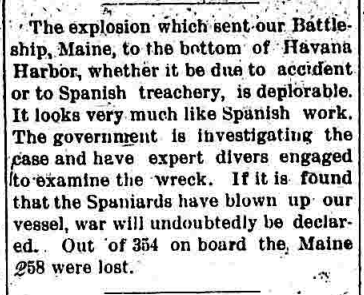
“The explosion which sent our Battleship, Maine, to the bottom of Havana Harbor, whether it be due to accident or to Spanish treachery, is deplorable. It looks very much like Spanish work. The government is investigating the case and have expert divers engaged to examine the wreck. If it is found that the Spaniards have blown up our vessel, war will undoubtedly be declared. Out of 354 on board the Maine 258 were lost.”
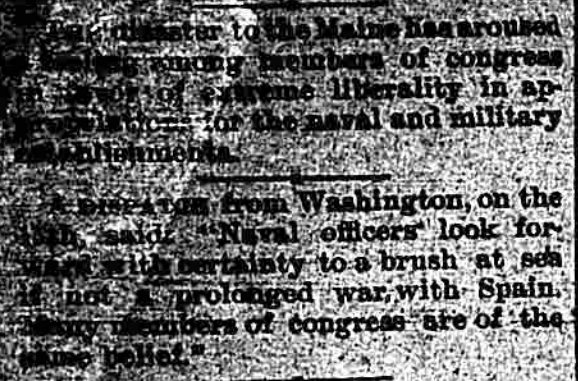
A dispatch from Washington said, “Naval officers look forward with certainty to a brush at sea if not a prolonged war with Spain. Many members of congress are of the same belief.”
United States Ambassador White and the American colony in Berlin were present in the American church, on the 20th, at the requiem service for the victims of the Maine. A commemorative discourse was delivered by Rev. Mr. Dickie.
Lieut. Gen. Weyler, who arrived in Barcelona, on the 17th, expressed the opinion, in the course of an interview, that the disaster which had befallen the United States war ship Maine in Havana harbor was “due to the indolence of her crew.”
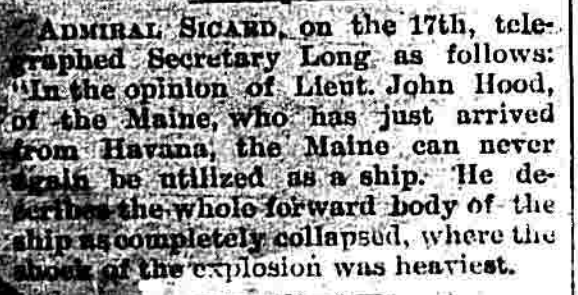
Admiral Sicard, on the 17th, telegraphed Secretary Long as follows: “In the opinion of Lieut. John Hood, of the Maine, who has just arrived from Havana, the Maine can never again be utilized as a ship.” He describes the whole forward body of the ship as completely collapsed, where the shock of the explosion was heaviest.
Capt. Sigsbee, in the telegram from Havana, of the same date, stated that he was not prepared to express an opinioin on this point, but counseled suspension of judgment.
Speaking of the awful disaster to the battleship Maine, Rear-Admiral Belknap, on the 16th, said it was a very significant thing that the Maine should have blown up in that particular harbor at this particular time.
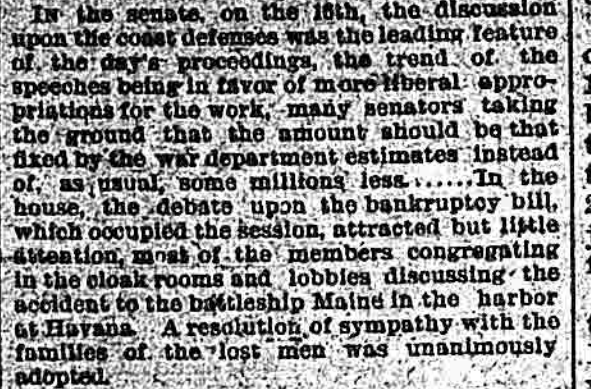
In the senate, on the 16th, the discussion upon the coast defenses was the leading feature of the day’s proceedings, the trend of the speeches being in favor of more liberal appropriations for the work, many senators taking the ground that the amount should be that fixed by the war department estimates instead of, as usual, some millions less. In the house, the debate upon the bankruptcy bill which occupied the session, attracted but little attention, most of the members congregating in the cloak rooms and lobbies discussing the accident to the battleship Maine in the harbor at Havana. A resolution of sympathy with the families of the lost men was unanimously adopted.
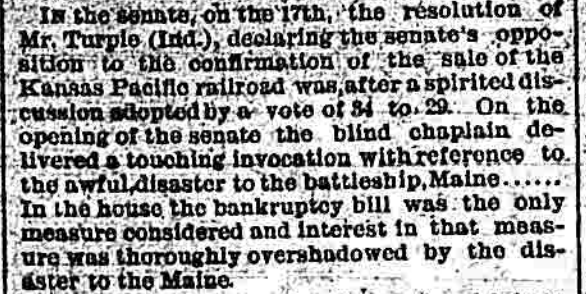
In the senate, on the 17th, the resolution of Mr. Turpio (Ind.), declaring the senate’s opposition to the confirmation of the sale of the Kansas Pacific railroad was, after a spirited discussion adopted by a vote of 34 to 29. On the opening of the senate the blind chaplain delivered a touching invocation with reference to the awful disaster to the battleship, Maine. In the house the bankruptcy bill was the only measure considered and interest in that measure was thoroughly overshadowed by the disaster to the Maine.
In the senate on the 18th, a sensational debate was unexpectedly precipitated by consideration of a resolution offered by Mr. Allen (Neb.), directing the committee on naval affairs to investigate the disaster to the Maine, the intimation being made and strongly resisted that an investigation by naval officers would be in the nature of a whitewash of delinquent officers. In the house the debate on the bankruptcy bill was continued, several speeches for and against the measure being delivered. The session lasted until 5:55 p. m.
The feeling at Madrid over the bare suggestion that the disaster to the Maine might have been due to Spanish treachery, is one of the greatest indignation at the thought that the Americans should believe Spaniards so lost to honor and hospitality as to be guilty of such baseness.
Up to the 18th not one word of assurance had been received from Madrid or Havana that the Havana harbor is not mined, as has been repeatedly charged in this country and in Havana.
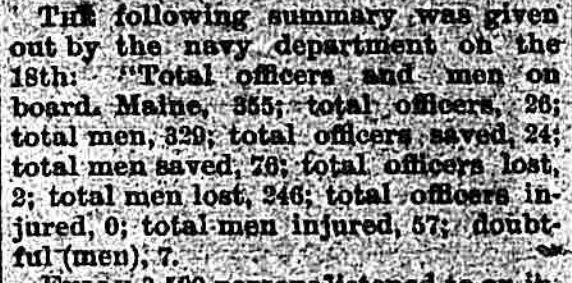
The following summary was given out by the navy department on the 18th: “Total officers and men on board Maine, 355; total officers, 26; total men, 329; total officers saved, 24; total men saved, 76; total officers lost, 2; total men lost, 246; total officers injured, 0; total men injured, 57; doubtful (men), 7.”
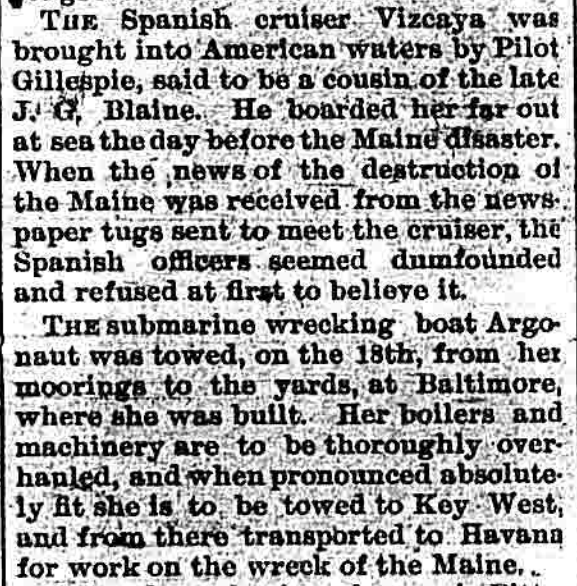
The Spanish cruiser Vizcaya was brought into American waters by Pilot Gillespie, said to be a cousin of the late J. G. Blaine. He boarded her far out at sea the day before the Maine disaster. When the news of the destruction of the Maine was received from the newspaper tugs sent to meet the cruiser, the Spanish officers seemed dumfounded and refused at first to believe it
The submarine wrecking boat Argonaut was towed, on the 18th, from her moorings to the yards, at Baltimore, where she was built. Her boilers and machinery are to be thoroughly overhauled, and when pronounced absolutely fit she is to be towed to Key West and from there transported to Havana for work on the wreck of the Maine.
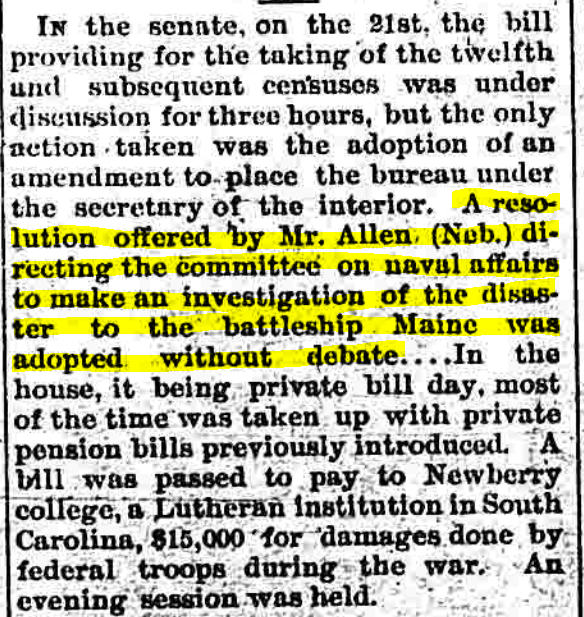
In the senate, on the 21st, the bill providing for the taking of the twelfth and subsequent censuses was under discussion for three hours, but the only action taken was the adoption of an amendment to place the bureau under the secretary of the interior. A resolution offered by Mr. Allen (Neb.) directing the committee on naval affairs to make an investigation of the disaster to the battleship Maine was adopted without debate. In the house, it being private bill day, most of the time was taken up with private pension bills previously introduced. A bill was passed to pay to Newberry college, a Lutheran institution in South Carolina, $15,000 for damages done by federal troops during the war. An evening session was held.
It was stated, on the 21st, that it would be the policy of the house leaders to prevent, as far as possible, any agitation of matters relating to Cuba or the Maine disaster in the immediate future. Pending the result of the official investigation they believe it is wise and the part of good public policy to maintain silence.
Are Facts Being Concealed?
Senator Mason, of Illinois, So Charges in the Senate
Washington, Feb 19—Mr. Mason, of Illinois, has offered an amendment to the Allen resolution for an investigation of the Maine disaster, providing for a special committee to make the investigation.
Mr. Hale asked that the matter not be pushed.
Mr. Mason, in reply, said that it was evident that the facts in regard to Cuba were being concealed from the people of the country and from congress.
I hope you all enjoyed reading the reactions and opinions as much as I did!

 The O'Fallon Public Library News